How DDEX AI music credits work, and why some are missing on Spotify
ElevenLabs has joined DDEX, the music industry's standards body, as a full member. Here is how AI contributions are supposed to travel from artist to Song Credits, and where they can go missing.

Drafted with AI assistance. Reported and edited by ChorusWire Staff. How we use AI
What we know
- ElevenLabs joined DDEX as a full member, per Digital Music News (Nov. 5, 2026). It was not the first AI-related company to join: Voice-Swap announced full membership on Sept. 24, 2026.
- DDEX standards are free to implement with a free implementation licence; membership is not required, per DDEX.
- DDEX's ERN data dictionary already includes a ContainsAI flag (recording-level yes/no). A broader Generative AI Declaration Standard (GAI-D) is in development, with publication expected in early 2027, per Digital Music News.
- Spotify said in Sept. 2025 it would support an AI-disclosure credit standard developed through DDEX; an update says a beta launched April 16, 2026 and credits appear in Song Credits on mobile.
- Spotify says the absence of an AI credit does not mean AI was not used, and not all distributors support disclosure yet.
- Deezer says it tags AI music via detection and will offer a toggle to exclude fully AI-generated music before the end of 2026.
When Spotify displays an AI contribution in Song Credits, it is showing information supplied through music-industry partners, not a conclusion reached by an AI detector. Whether that information appears depends on what was disclosed and which systems support it. The standards body whose formats carry that metadata is DDEX, and on Nov. 5 it announced that ElevenLabs, an AI audio company, had joined as a full member, Digital Music News reported. ElevenLabs is not the first AI-related company to join: Voice-Swap, an AI voice company, said on Sept. 24 that it had become a full member, which it described as a first for a dedicated AI voice company (Voice-Swap).
What DDEX actually does
DDEX describes itself as a standards-setting organization for the digital music value chain. The problem it solves is mundane. A label, a distributor and a streaming service all need to write down who made a track, who owns it and how it was sold in the same way, so machines can pass that information along without anyone retyping it. DDEX calls this metadata, and says its standards define both the format of the messages and the method for exchanging them between companies (DDEX, About).
The standards are free to use. DDEX says you do not have to be a member to implement them; you need a free implementation licence (DDEX, Standards). Its standards page lists message types ranging from release notifications to sales reporting and rights data. Membership is a separate thing: Digital Music News says DDEX has more than 150 members, including Amazon, Apple, Google, Spotify, Universal Music Group, Sony Music Entertainment and Warner Music Group.
How an AI credit is supposed to reach you
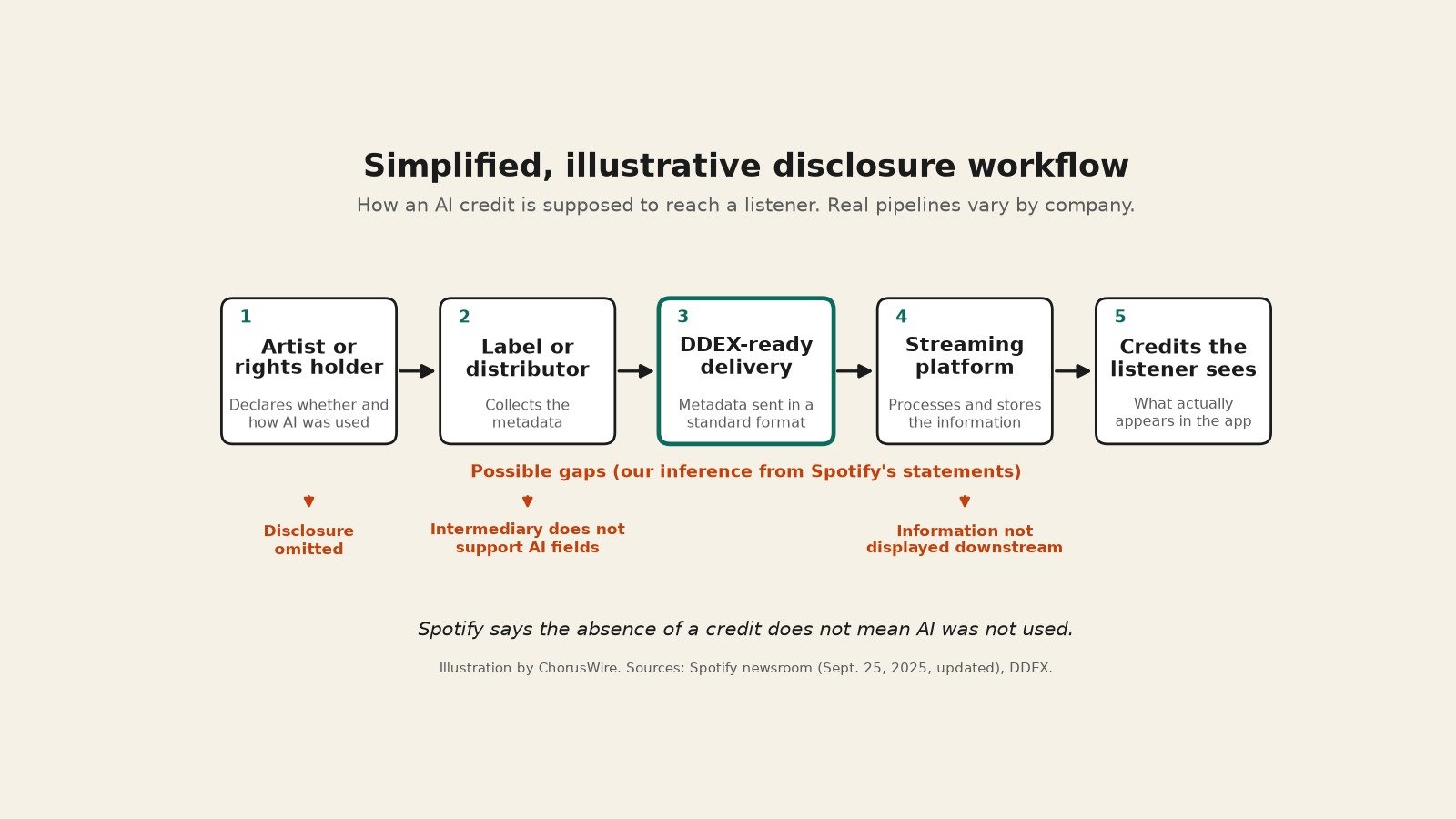
Spotify laid out its version in a September 2025 post. It said it was helping develop, and would support, a new industry standard for AI disclosures in music credits through DDEX. The information is submitted by labels, distributors and other music partners, and Spotify then displays it in the app. The standard is meant to let artists and rights holders indicate where AI played a role, such as vocals, instrumentation or post-production (Spotify newsroom).
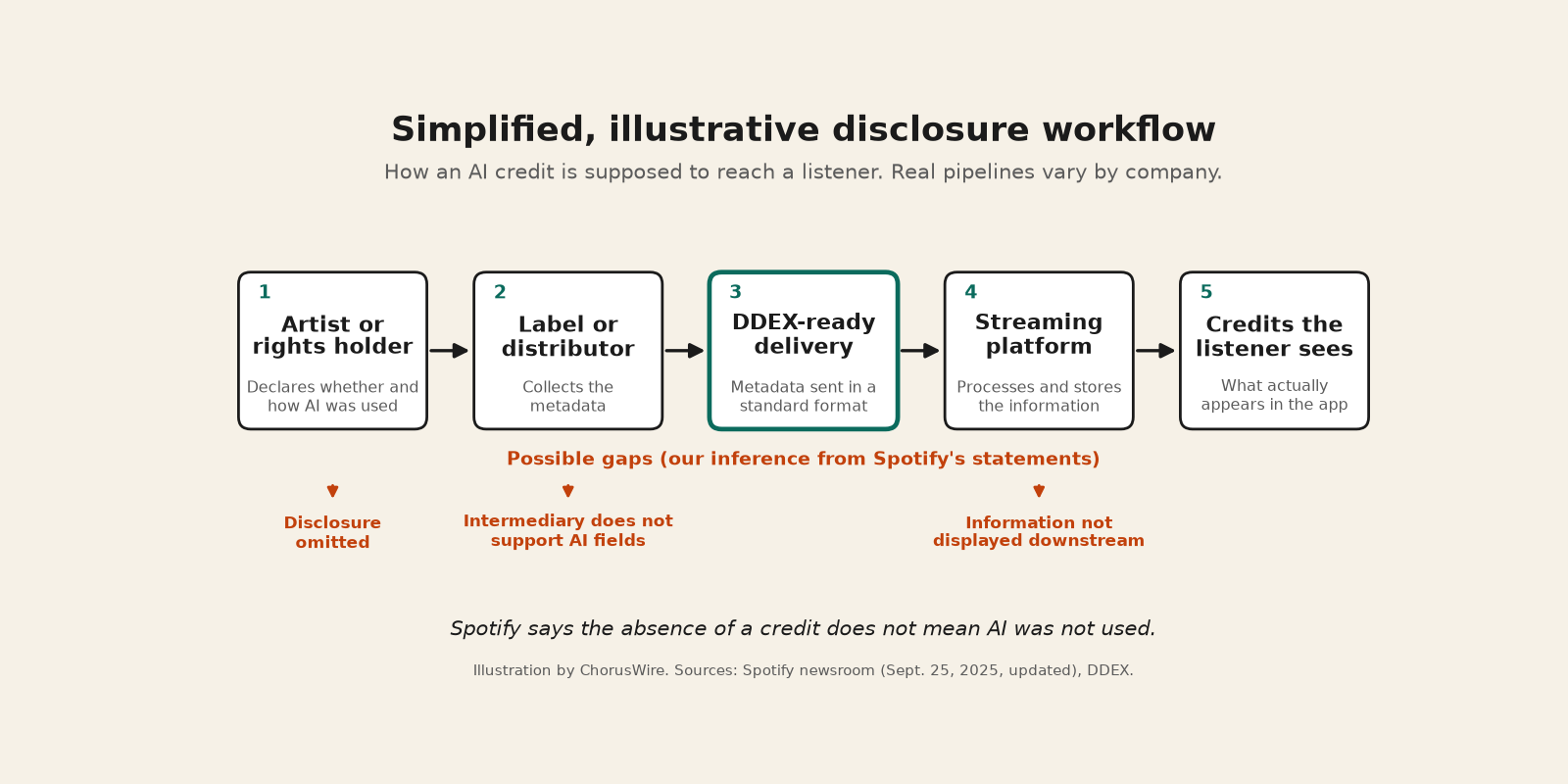
An update to that post says Spotify launched a beta on April 16, 2026 that lets artists share how they used AI. Where an artist has disclosed through a label or distributor, the credits for specific contributions such as vocals, lyrics or production appear in Song Credits on mobile. Spotify says tens of thousands of AI credits are being submitted daily; that counts credits, not necessarily songs or artists. It also gives the caveat that matters most for listeners: because the system depends on artist disclosure, the absence of a credit does not mean AI was not used. And not all distributors enable artists to disclose yet.
What the existing DDEX message can declare
This is not only a future standard. DDEX’s published data dictionary for its release-notification messages already includes a flag called ContainsAI, defined as indicating whether a resource contains content generated using AI (DDEX data dictionary, ERN 4.3.2). That is a yes-or-no marker on a recording. It does not say which part of a track used AI, or how. Spotify’s Song Credits show finer detail, naming contributions such as vocals, lyrics or production, so how the two relate is a question for the companies that implement them.
What is still being written
Separately from those existing fields, the DDEX AI Working Group is developing a broader Generative AI Declaration Standard, known as GAI-D. According to Digital Music News, the group has finished collecting member comments on the committee draft, which now moves through DDEX’s peer review, with publication expected in early 2027. That is an expected date, not an official deadline. How far the future standard will change existing disclosure workflows has not been established in the sources we reviewed. The AI Working Group held its first in-person meeting in Nashville on Sept. 9 and 10.
Why ElevenLabs joining matters, and what it does not mean
Our reading: a disclosure standard written without the companies whose tools make the audio is likely to miss how those tools work, so having AI companies at the table is useful. ElevenLabs said it is looking forward to taking part in DDEX plenaries and working groups. But joining a working group is not the same as shipping the field. DDEX says anyone can implement its standards with a free licence, and nothing we found says that membership obliges a company to put an AI credit into any file.
Disclosure is not detection
Streaming services are using two different approaches, and they answer different questions.
| Approach | Who decides | What it can catch | Limit |
|---|---|---|---|
| Disclosure (Spotify credits via DDEX) | The artist or label states it | Partial AI use that people choose to declare, such as vocals or production | Anything not declared |
| Detection (Deezer) | Deezer’s own classifier | Fully AI-generated tracks, including output from generators such as Suno and Udio | Focused on fully AI-generated tracks; performance on partly AI-assisted music and unfamiliar models may differ |
The last column is our reading of how each system is built, not a claim from either company. Deezer says its detector can work without a model-specific training dataset, and that it has tagged AI-generated music since June 2025. In an Oct. 13 announcement it said a toggle to exclude fully AI-generated music from search results will arrive before the end of 2026 (Deezer newsroom). Those are Deezer’s claims about its own system, and we have not seen independent testing of it. The practical difference: one system tells you what the artist says, the other tells you what a classifier found.
What to do with this
- Listeners: check Song Credits in Spotify’s mobile app. A missing AI credit is not proof that a track is human-made.
- Artists: ask your distributor whether it supports AI credit fields. Spotify says not all do yet.
What we could not confirm
- The text of the GAI-D draft was not available in the sources we reviewed.
- Spotify has not published a share of tracks that carry AI credits, only the “tens of thousands daily” figure.
- The early-2027 publication date comes from Digital Music News’s report of the DDEX announcement. We did not retrieve DDEX’s own press release.
- DDEX’s release notes for ERN 4.3.1 are reported to add signals for recordings and individual contributions made wholly or partly with generative AI. We could not load that page directly, so check DDEX’s release notes for the exact fields.
- Some press reports describe other Spotify AI labels. We left them out because we could not confirm them on Spotify’s newsroom.
Part of our coverage of AI music and streaming.
Quick answers
What is DDEX?
DDEX is a standards-setting organization for the digital music value chain. Its standards define the format of the messages labels, distributors and streaming services use to pass metadata such as who made a track and who owns it. The standards are free to implement with a free implementation licence.
Does an AI credit on Spotify mean an AI detector found AI?
No. Spotify says AI credits in Song Credits are information submitted by labels, distributors and other music partners. They are not a conclusion reached by a detector.
Does a missing AI credit mean no AI was used?
No. Spotify says that because the system depends on artist disclosure, the absence of a credit does not mean AI was not used, and not all distributors enable artists to disclose yet.
What is the GAI-D standard?
GAI-D is the Generative AI Declaration Standard being developed by the DDEX AI Working Group. According to Digital Music News, publication is expected in early 2027, which is an expected date and not an official deadline.
See ChorusWire first in Top Stories. Add us as a preferred source on Google.
Add as preferred sourceSources
- Digital Music News: DDEX Announces ElevenLabs as First AI Company to Join Its Ranks, Nov. 5, 2026 (its "first" claim is contradicted by Voice-Swap) (accessed Nov. 7, 2026)
- Voice-Swap: Voice-Swap joins DDEX as the first dedicated AI voice Full Member, Sept. 24, 2026 (accessed Nov. 7, 2026)
- DDEX: About (accessed Nov. 7, 2026)
- DDEX: Standards (accessed Nov. 7, 2026)
- DDEX Data Dictionary, ERN 4.3.2: Flag (ContainsAI) (accessed Nov. 7, 2026)
- Spotify newsroom: Spotify Strengthens AI Protections for Artists, Songwriters, and Producers (Sept. 25, 2025, with later update) (accessed Nov. 7, 2026)
- Deezer newsroom: Deezer will let you fully exclude AI-generated music from your streaming experience, Oct. 13, 2026 (accessed Nov. 7, 2026)
